


Transcript (ish)
Dzogchen is the branch of Buddhism that I’m most influenced by; that I love most.
It’s extraordinarily compelling and exciting and beautiful. It’s in some sense the basis of pretty nearly everything that I write.
It has several serious problems, though.
One is that you can’t sell it. And this problem is nearly fatal.
Every religion has to have some economic basis. This is something we resist in the West; going back to Martin Luther, whose slogan was “Every man his own priest.” His idea was that everybody (every man at least) should be able to read the Bible in his own language, and understand it. Then he should form his own direct relationship with God, without a priest intermediating. This is a very attractive idea! It eliminates the class of religious professionals, who had become corrupt and parasitic in Europe at that time.
The problem is, this doesn’t actually work. Most people are not capable of being their own priests. Not any more than most people are capable of being their own plumber. DIY religion sounds great, but hardly anyone can make it work. You need professionals to do the job. So, in many Protestant denominations, there’s a “pastor” role which is officially definitely not a priest, but performs most of the same functions in practice.
Buddhism is also a religion that needs religious professionals. In Asia, there were professional Buddhist clergy. And, in Asian cultures, there were various economic arrangements that made it feasible to support a class of religious professionals. Those depended on cultural patterns that we don’t have in the West. The main one, monasticism, mostly doesn’t work in the West, despite attempts.
This is a big problem for Buddhism in the West. On the one hand, we want, and actually need, full time professional teachers. But we don’t think we ought to pay for them. And it’s not clear what the payment model should be. So we’ve mostly followed the pastor model, from Protestantism. That has worked pretty okay, although not ideally, in many cases. It doesn’t work for dzogchen.
But the Asian models didn’t work for dzogchen, either! The problem is, dzogchen has nothing to sell. At least, not in its original version, which is the one that I care about. That’s sometimes called “pristine” dzogchen. Later, dzogchen got modified, repeatedly over centuries, to overcome this problem, along with several other genuine problems with it. So Tibetans added things that you could sell, but those actually messed it up, I think.
You can sell secrets, but dzogchen isn’t secret
One thing you can sell is secrets. So Scientology, if you keep going with it, at each level, you pay much more, and you get told the next chunk of the secrets. But all of the secrets of Scientology eventually came out, and you can find them on the internet for free.
In Tibet, they tried this model, and supposedly dzogchen was extremely secret. That pretense was retained until dzogchen came to the West, and then the store got given away. So now you can find the whole thing on the internet.
The original version of dzogchen simply told you what enlightenment is and what it’s like. And that’s extremely simple. It’s two or three sentences, maybe. And it’s not easy to sell two or three sentences!
And also, they’re no use, because they don’t make any sense. What is enlightenment? What’s it like? If you understand the brief description, you say, “yeah; yeah, that’s what it’s like.” And if you don’t understand it, there’s no further explanation possible. You can ask questions, and the answers may sound interesting, but usually they don’t help. I have a post about this, called “A non-statement ain’t-framework.” It explains why you can’t explain dzogchen.
What actually happens is: if you meditate in certain ways, quite a lot, eventually you start to see it. And then, at that point, the two sentence explanation can suddenly make sense.
So you could try to sell this secret, but it’s useless, and people would feel like they didn’t get their money’s worth. And anyway, it’s on the internet!
In Tibet, secrecy mostly didn’t solve the economic problem either. So the way they addressed it was to add more things to dzogchen which you can sell. Two of them are methods and entertainment.
You can sell methods, but dzogchen has no methods
You can sell a method for getting to enlightenment. In Tibet, tantra is considered the main method for getting to enlightenment. So you can sell tantra. Tantra has many complicated methods, and it takes a lot of in-person instruction to learn those methods, and you can charge for the expertise and labor of teaching them. So that works for tantra.
(I should say that in Buddhism, as in Christianity, it’s mostly considered gauche to put a straightforward price tag on religious services. So instead there are implicit norms and deniable negotiations. I can see good reasons for this, but on the whole I find transparent arrangements more copacetic.)
There’s no point asking ChatGPT how to get to Paris if you’re in Paris.
Anyway, this doesn’t work for dzogchen, because it doesn’t have any instructions. Because it’s not a path. It’s not a method. There is no method. It’s just a description, of enlightenment. Once you’re enlightened, you don’t need a method. “Dzogchen,” in Tibetan, means “full completion.” It’s what you get when you’ve completed tantra. You don’t need any instructions at that point. It’s like: there’s no point asking ChatGPT how to get to Paris if you’re in Paris.
So, to make dzogchen saleable, a whole lot of methods got added to it, which (in my view) violate the spirit of the thing, and are actually a step backward. The methods are kind of dzogchen-flavored, but they’re essentially tantric methods.1 And tantric methods are great. I love tantra! But it’s not dzogchen. And it’s missing the point.
Student: How do I get enlightened?
Teacher: You already are.2
Student: No I’m not.
Teacher: . . .
Student: Everybody is doing these way-out esoteric mystic things and getting enlightened. Tell me how to do that!
Teacher: [sighs] OK, first you need to stand on your head…
You can sell entertainment, but dzogchen isn’t entertaining
Another thing you can sell is entertainment. Most people in Medieval Tibet didn’t have internet access, so there wasn’t enough entertainment to go around, and that created demand for something better than watching yaks chew their cud. So rituals, which had been genuinely religious, were recycled as entertainment. Those became the main form of public spectacle in Tibet. And lots of extra foofaraw was added to these religious rituals, to make them more entertaining. Primarily, this was done with tantra; but once you’ve started adding methods to dzogchen, you can do the same thing, so you can have big public dzogchen rituals.
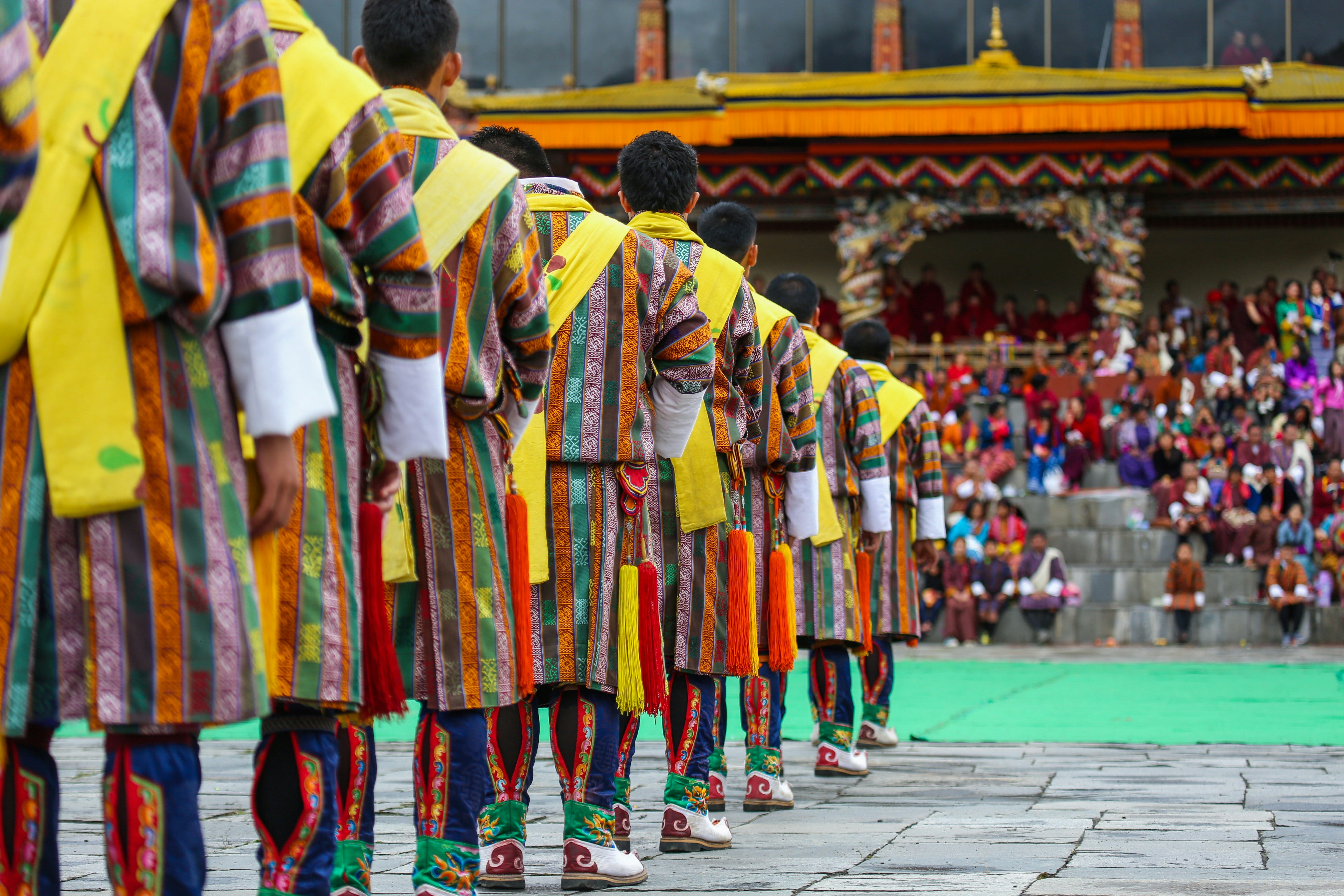
That is actually a contradiction in terms, again in my view. If pristine dzogchen could be said to have any rituals at all, they take about two seconds, and are improvised one-on-one on the spot. But that’s not something you can charge for.
And because dzogchen had the reputation of being the fanciest kind of Buddhism, the idea was it must have super-duper rituals. So a dzogchen ritual was something very special that you would pay a lot of money to go and see, and it would be highly entertaining; or you’d hope it would be. That subsidized the actual work of dzogchen professionals, so maybe it was a good thing. But it’s dishonest.
Dzogchen is still available, despite its unsellability

So, where does this leave us, here and now?
It leaves us with the main forms of “dzogchen,” the ones widely taught and practiced, being diluted, adulterated with tantra. Maybe you could even say corrupted. And that’s fine, if you understand that’s what you are getting. They are probably great for what they are! I don’t know, I haven’t tried them seriously. Tantra is great, and tantra that’s pretending to be dzogchen is probably extra good! It’s just, there’s a conceptual confusion here, and it’s a motivated confusion, and this results in a lot of incoherent explanations, and duplicity, maybe even a kind of sleaziness in the relationship between teachers and students.
I said that the unsellability of dzogchen was nearly fatal. But fortunately, the original, pristine thing is still available. In fact, it’s much more available than it ever was in Tibet, or at least than it had been in hundreds of years, because there’s no longer any attempt at secrecy. But if you want it, you need to know what you are looking for.
And you aren’t going to get it on its own—unless for some reason you can understand the two-sentence explanation when you find it on the internet. No one can sell it to you, so it only comes as part of a package deal.
You can get full-strength, unadulterated dzogchen from someone who mostly teaches tantra, yet maintains a clear distinction between the two. You can get it from someone very holy, with a gold-embroidered hat, who drops the two sentences in the middle of a days-long lecture series on archaic Tibetan metaphysics. You can get pristine dzogchen from a professor in a Western university classroom, who gives you the straight dope in an off-hand way while lecturing on Buddhist history. You can get it from an informal meditation teacher. That’s probably the best bet!
You might get it from a crazy street person in a Starbucks, who trades it for your building her a web site.
David Germano’s “The Funerary Transformation of the Great Perfection” is an influential history of this process. “The earliest public Great Perfection traditions are marked by the absence of presentations of detailed ritual and contemplative technique, and by the absence of funerary Buddhism. We will term this “pristine Great Perfection,” which […] consists of aphoristic philosophical poetry with terse experiential descriptions lacking any detailed outline of practice. There is then a gradual incorporation of the description of diverse ritual and contemplative techniques and funerary elements.”
It is easy to misunderstand this. “Enlightenment” is a slippery term that means quite different things in different Buddhist contexts. Usually, for clarity, it’s best avoided altogether. “You are enlightened” and “You are not enlightened” are both true. “You are enlightened” is always true. It’s meaningfully and importantly so; not just trivially, not just on a technicality, or on the basis of a gimmicky, unhelpful, rug-pull definition.


