

Unavailable dakini catalyst
Seven tales of love and liberation through wrenching revisionings.

You are stuck.
Your life works. Your marriage works. Your emotions behave themselves. Everything is under control. Everything is… slightly stale and unsatisfactory.

Then a cannibal witch casts a magnetic spell on you.
Or a barbarian warrior prince abducts you on horseback.
The system of your life collapses in twisted wreckage, and you fall into the storm-tossed ocean between stages four and five.
Well, that was dramatic, wasn’t it?
This is about ways romantic relationship can accelerate personal development—sometimes dramatically or traumatically.
Love and liberation through wrenching revisionings
I will tell seven true-ish1 stories about romantic relationships and how they catalyzed developmental stage transitions. They are less dramatic than a horseback abduction, but maybe not much less dramatic.
Elena: A life-or-death decision forced me out of relational stage 3, and into the confusion of 3.5 nihilism.
Liota: A lesbian feminist sadomasochist witch challenged me to grow up into a stage 4 relationship.
Maya: An extramarital encounter threw my colleague James into a profound depression.
Astarte: Ideology repeatedly wrecked a recurring romance.
The princess: A non-existent goddess guided me toward stage 5.
Rin’dzin: Two people who had given up on romance worked together toward stage 5.
Mauricia: Protected by unavailability, she may have catalyzed the most important knowledge in the world.
Romantic catalysis
According to adult developmental stage theory, three radically different sorts of selves, and three radically different sorts of relationships, are typical for adults. Each stage, as you achieve it, is a triumphant accomplishment. Each stage has distinct advantages over previous ones. You may remain comfortable in a stage for years, decades, or a lifetime.
Each stage also has serious limitations. For some people, those eventually become increasingly uncomfortable. As you outgrow a stage, you feel stifled and trapped in a too-small self and too-small relationships. It is time to move on. You need to let go of the self you have, to build a new one of a completely different sort. You need to let go of your theory and habits of relationship and learn completely new ones.
However, for each stage, the next way of being is literally inconceivable. Explaining stage 4 (systematic) to someone in stage 3 (communal) is usually fruitless. They simply cannot hear what you are saying. Likewise attempts to explain stage 5 (fluid) to someone in stage 4.
This makes the transition from one stage to another inherently difficult. You exit one stage, but cannot yet see where you are headed. You must traverse an ocean gulf to reach the next solid land. That generally takes a few years, during which you may frequently feel disoriented. You are no longer willing to operate in the too-limiting former mode, but not yet able to operate consistently in the next. To deliberately let go and move forward, you must somehow trust that a better destination exists.
Stage transitions can go relatively smoothly, or be wrenching, terrifying, sometimes fatal. That can depend on your personal psychological resources. It may depend even more on how much support you get from your social and cultural environment. For example, some adult institutions provide helpful guidance for the communal-to-systematic transition (3 to 4). However, you must accept their somewhat rigid framework. The military is a solid example, as are some sorts of civilian employment. Universities used to provide this support, but mostly no longer do. (My post “Ofermōd” explains that.)
Also unfortunately, there has never been good institutional support for the systematic-to-fluid transition (4 to 5). (My post “A bridge to meta-rationality vs. civilizational collapse is about this.)
As an alternative, a close relationship between two people can support development. That can be from 3 to 4, or 4 to 5. My story “The Cofounders” is a “business fiction” explanation of the 4-to-5 transition in the domain of professional relationship. In that story, it goes pretty smoothly.
A romantic relationship can also catalyze a stage transition. The first three stories in this series, “Elena,” “Liota,” and “Maya,” explain transitions from 3 to 4 in that context.
Romantic 4-to-5 transitions are the topic of stories 4–7, and of the second half of “Maya.” Those are fairly rare, whereas the 3-to-4 relational transition is quite common. I understand them less well. Some relationship experts probably understand them better than I do, but I have found no extended discussion. That means I can offer only limited and tentative advice.
Instead, I mainly describe things that can happen. I know they can happen, because I have experienced them, and have talked with other people who have experienced them. Just knowing that they can happen may be helpful. (Or at least interesting!)
Years from now, you might remember reading this post, and suddenly relational changes in your life make better sense. This could be relevant:
When you feel ready to make the 4-to-5 transition, but can’t get unstuck from relational systematicity.
To be prepared for the transition, when it seems to be about to happen, or if it is starting for reasons beyond your control. For example, when you have just been abducted by a barbarian warrior prince, or entranced by a black magic witch. These inconveniences may be growth experiences.
If you have started the transition and are finding it difficult. Recognizing that you are at this point is unusual! A major benefit of stage theory is giving you a conceptual framework for understanding confusing, sometimes traumatic, psychological and relational changes.
For understanding your experience in retrospect, if you are a fair way through the transition, or have completed it.
Protected by unavailability
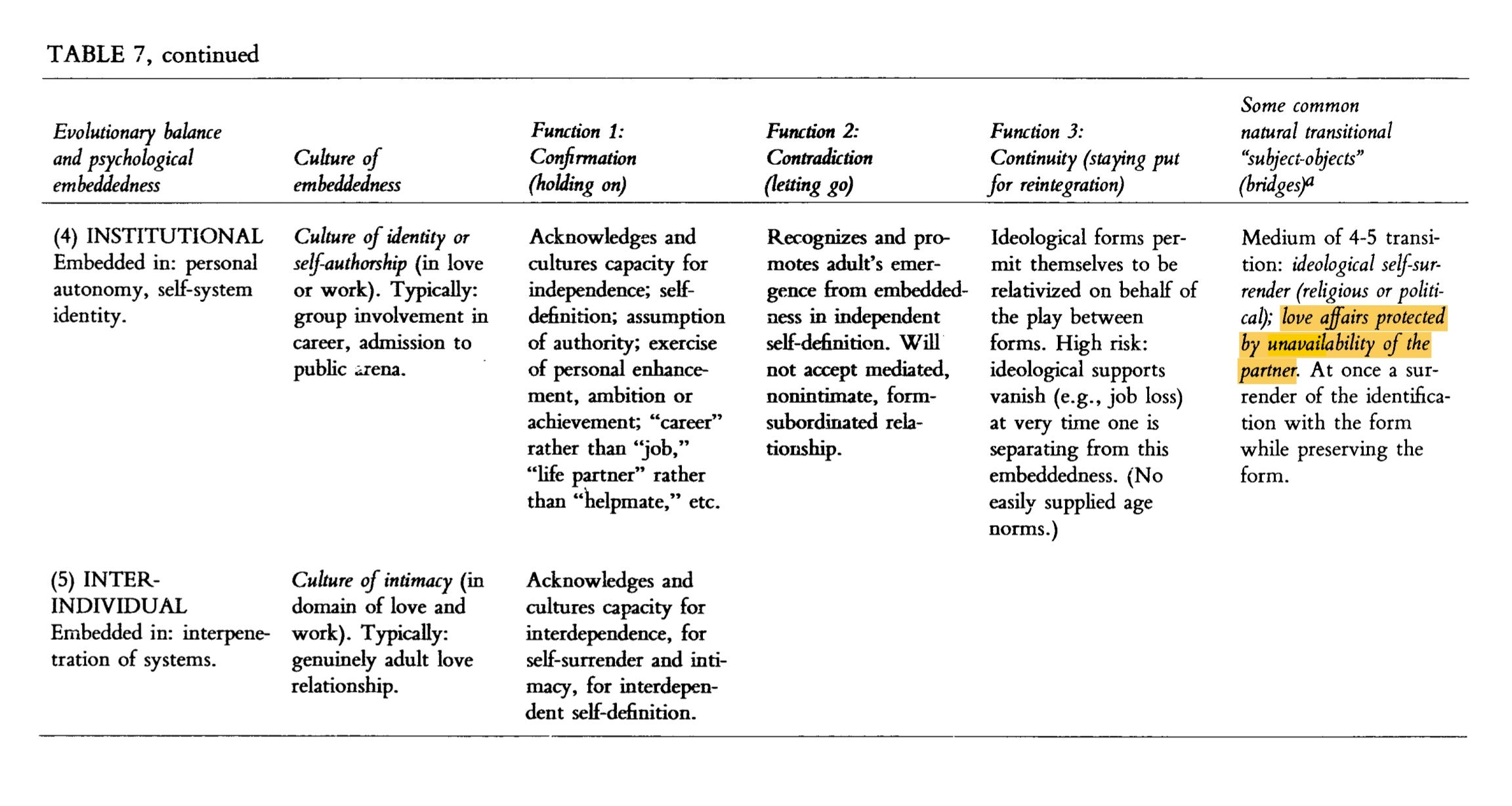
This series was inspired by an enigmatic, entirely unexplained point buried deep in Table 7 in developmental psychologist Robert Kegan’s book The Evolving Self:
Medium of 4–5 transition: love affairs protected by unavailability of the partner.
What could that mean?
Protected by unavailability??
I long puzzled over this. Then I realized I had seen it happen.2 Originally, I intended to explain my understanding with a single story. Then I found more that each fit the pattern, but are quite different from each other.
And then I realized it would be more useful to write stories illustrating the 3-to-4 transition. That’s a much more common challenge than the 4-to-5 one! So I added ones about that. Although those are not about unavailable dakini catalysts.
How systematicity works, and how it fails
Systematicity abstracts the messy details of actual-world situations into a more-or-less formal structure of principles, policies, and procedures. My post “Rational romance” explains how that works in the domain of relationships.
The actual world is nebulous, and cannot be fully or accurately described or manipulated by any system. Part One of Meta-rationality explains how systematicity fails, sometimes catastrophically, when you overlook its limits.
How can systematicity work, when it does, considering that all principles, policies, and procedures are necessarily inaccurate? Part Three explains: we have to do practical and conceptual work to bridge the gap between theory and actuality. Two of its strategies are particularly useful in relational systematicity:
Sanity-checking: We have to accept that rationality often comes to wrong conclusions. When the theory tells you to do something that seems clearly wrong, then it quite likely is, and you should do something else. Or at least think again, differently!
For example, toward the end of “Elena,” I concluded from my theory of relationship that facts rationally implied I had to put all my energy into taking care of her for the rest of my life. That was obviously wrong. I knew it was wrong, but I mistakenly prioritized rational deduction over what I could see happening. Earlier in the relationship, my sense-making was just overwhelmed by her intense feelings. Toward the end, I was trying to be systematic, but wasn’t yet up to it, and did it badly.
Shielding: We reorganize our environment to minimize external influences that might interfere with the operation of the system.
In the first half of “Maya,” James abandons his career in order to preserve a nascent systematic self. In the second half, his inamorata describes how she ghosted men she was attracted to, to preserve the system of her marriage and family.
Systematicity subordinates actuality to principles. That is both its source of power, and its limitation—in relationship, as in technical work. A systematic relationship subordinates the other person to its system. Depending on how rigidly you adhere to principles, the human being you think you love may disappear, replaced by an abstract representation of their functional role in your model of how a relationship should work.
At stage 4, each new relationship is exciting; but then, typically, it grows stale. Your representation of the person is much less vivid than their actuality. Kegan tells the story of “Michael,” a successful businessman in his mid-thirties, who has a series of moderately serious, limited, rational relationships with women that each become unsatisfactory.3 I recognized myself as I was in my mid-thirties: a successful businessman who had a series of year-long, moderately serious but limited rational relationships with women. (I discuss this near the end of “Liota.”) Michael and I thought this was because each woman wasn’t quite right for us. Eventually, though, we started to realize that the problem was our own systematicity: our demand that the relationship conform to our personal limits.
How romantic longing can explode rationalism and free you for fluidity
“Shielding” could also be described as “relevance control.” Systematicity fails when circumstantial factors become relevant that the rational abstractions render invisible. Shielding protects the smooth operation of the system by keeping chaos out.
But sometimes a black magic witch appears and weaves a spell around you. Or a barbarian warrior prince gallops up and hoists you onto his saddle.
Metaphorically: a witch or barbarian is someone you cannot subordinate to your system.
If you start a relationship with someone available in terms of your system, you remain stuck in stage 4.
If you fall hard enough for someone unavailable, their meaningfulness is so intense it bursts your system apart.
Then the witch or barbarian is suddenly the most relevant thing in your world—and cannot be captured by your relational rationality.
Exit stage 4, into the wilderness between 4 and 5.
Catastrophic catalysis. A chaotic confusion in which you throw aside principles, violate policies, and ignore procedures.4 The self you thought you were is dying: in pain, in hope, in desperate longing for the beloved you cannot have.
And then, perhaps, creative (re)construction: of a new self and a new way of relating: stage 5, the fluid mode.
What does unavailability protect an affair from?
It protects the affair from: you.
From you as you were: a smoothly-operating, well-shielded machine.
There are many ways someone may be “unavailable.” We’ll see some surprising ones in the upcoming stories.

In the second half of “Maya,” the professor’s pattern of ghosting men she had one-night stands with made her and James mutually unavailable—in the way they wanted in the moment. That made transformation possible, with a good outcome for all parties.
Lack of sexual consummation is often helpful, as in “Astarte,” “The princess,” and “Mauricia.” It’s not necessary, though. Someone who isn’t available in the way you want can be the catalyst. You might have a sexual affair with them, but they aren’t willing to leave their marriage, prioritizing it above you; or they just don’t take the relationship with you as seriously as you do.
That is what happens in “The puzzle of meaningness.” It’s about a transition forward out of stage 4, catalyzed by an extramarital romantic relationship ending.5 This is another story showing how stage transitions don’t have to be catastrophic. The protagonist is confused, deeply uncertain about their future, but seems in good spirits despite that.
It’s important to take ethical considerations seriously if you fall for someone else while in a monogamous relationship, whether or not a stage transition is involved. The protagonists indeed do that in “The puzzle of meaningness,” “Maya,” and “Mauricia.” This can result in your transitioning from a stage 4 understanding of ethics to a stage 5 one.6
A surrender of identification with the form
After “protected by unavailability,” the entry in Kegan’s Table 7 explaining the 4-to-5 transition continues:
At once a surrender of the identification with the form while preserving the form.
What does that mean?
Stage theory began with Jean Piaget’s four-stage theory of children’s cognitive development. He called the final stage, number 4, “formal operations.” That was full rationality, which he considered equivalent to formal mathematical logic.
In the 1970s, researchers in Piaget’s lineage discovered that some people go beyond formal rationality, and develop further cognitive capacities. They called this fifth stage “post-formal.”7 Cognitive stage 5 development requires letting go of rationalism, the belief that rationality is the ultimate mode of cognition.
That implies letting go of your congratulatory self-definition as someone who has mastered systematic, formal reasoning. This may precipitate a stage 4.5 post-rationalist crisis: since rationality is unreliable and inadequate, do I actually know anything at all? What am I, what can I be, if not a system of rational methods?8
This can eventually resolve as meta-rationality, stage 5 cognition, whose viewpoint is from above all systems. It engages with territories before, beneath, and around them. It sees through and past them, as transparent but sometimes-useful illusions. Meta-rationality requires a new type of self. You “become the space” and “come unstuck in time.”9 This does not mean rejecting rationality. Rather, it results in its more accurate application.
In the relational domain, stage 5 entails surrendering ideological commitment: not only to your particular theory of relationship, but to theorizing altogether. You surrender identification with any form of relationship. That does not mean rejecting your understanding of romantic rationality. You preserve the form: you remain cognizant of relationship ideologies, which often provide valuable understanding and skillful methods. However, your relationship is no longer limited by any form. Instead, you relate as spacious passion.
How the romance may go
You are not currently in a relationship. Your unavailable crush catalyzes your reorganization of your self into stage 5. They recognize you are now ready, and invite you join them in a stage 5 relationship. This is the best outcome!
They remain unavailable, but you are now ready for a stage 5 relationship with someone else, new and available. Also a great outcome!
You lack the courage to transition. You remain at stage 4. They disappear, disappointed.
The unavailable person becomes available before you transition, and you join them in a new stage 4 relationship. This might be enjoyable; but if you were ready for transition, it may stall your development. “Rinse and repeat” is a common outcome.
You were already in a relationship. The outside party remains unavailable. Your longing for them forces you into stage 5, and your current partner is able to transition roughly simultaneously. The relationship deepens and strengthens. “Maya” ends this way.
You were already in a relationship, and you transition to stage 5 personally, but your partner remains at 4 (or even 3). The relationship may become more playful, spontaneous, creative, due to your newfound fiveishness. However, that’s inherently limited if your partner stubbornly systematizes it. This seems to be what’s happening in “The puzzle of meaningness” at the end.
Understanding stage 5, even if only conceptually at first, can ease the transition. Practicing the six textures of completion, characteristic of stage 5, may help. Notice how the protagonist in “The puzzle of meaningness” develops open-ended curiosity in the face of nebulosity. For the other five textures, you can:
Feel wonderment at glimpses of a new way of being and loving.
Maintain good-natured humor about your own ridiculousness as you bumble through wrenching changes.
Shift the balance of your relational engagement from rigid rationality toward child-like playfulness.
Enjoy the vertigo of not-knowing what you are becoming, and what romance can mean for you.
Co-create a new, fluid relationship with your partner.
Warriors and witches
I’ve left unexplained part of the title of this post: dakini. That is the Sanskrit word for a witch. All seven stories are about witches…
The male counterpart of the dakini is the vira, Sanskrit for “noble warrior.”
A follow-on post, “The threat of the dakini & challenge of the vira,” concerns gender dynamics in romance, in Vajrayana Buddhism, and in stage transitions.
Six of the stories are true-ish, but I have deliberately changed names and details to protect identities. One story is entirely fictional, but it is about two actual people, whose real names I use, and it might also be true. Another is about a supernatural witch who doesn’t exist. That one is a true story, and you may meet her one day—if you are lucky. Most are from my own experience. They are based on my diaries and correspondence and memories. However, those are from decades ago, and my memory is murky. And my perception of events was one-sided at the time, and seems definitely distorted in retrospect. My present understanding of some of these relationships is rather different from the sense I made of them at the time. (Which is more real? How can the meanings of events can change? What is the meaning of a relationship, if not what we thought it meant at the time? How is it possible to be wrong about that?)
Or, I’ve seen a pattern that matches Kegan’s phrase. I’m not sure it’s the same thing Kegan was pointing at.
Robert Kegan, The Evolving Self, pp. 221ff.
See Kegan’s discussion of “Kenneth,” in The Evolving Self, pp. 233ff.
Although I didn’t mention stage theory explicitly in “The puzzle of meaningness.”
The midpoint of the 4-to-5 transition can involve dangerous ethical nihilism. See again Kegan on “Kenneth,” and “The puzzle of meaningness.”
I summarize this history near the beginning, and in the last section, of “What is stage five (like)?” Kegan provides more detail in The Evolving Self, pp. 228ff.
A brilliant case study is “Narcissism in the Epistemological Pit” by Thomas Swan and Suzie Benack, Journal of Adult Development, Vol. 9, No. 3, July 2002.
These are described in “What is stage five (like)?”
"Metaphorically: a witch or barbarian is someone you cannot subordinate to your system."
This strikes me as a good description of what it was like to have a baby and raise a young child. I wonder whether you've seen others talking about parenting as a catalyst for stage change as well. Seems likely I'm guessing.
Is doing a committed long term meditation practice a cheat code for reaching stage 5, even in the absence of other triggers, support systems, etc? Or, to put that another way, how could a person that is not particularly attached to anything be attached to systematicity? (Obviously i also recognize than an enlightened person wouldnt care about "reaching stage 5").