

Seeing like a Good King
Vision for nobility in an age of chaotic decline and unexpected possibilities

We all know what a Good King is.
I mean “Good King” not as a historical reality; an actual king who was a good person. Many people believe that’s not even possible, but it’s not relevant here.1 I mean “Good King” as an archetype, or narrative character type. We know what Good Kings are from stories: from fantasy novels, and films, and video games.
A Good King uses power wisely, creatively, and justly.
I recommend we all aspire to being Good Kings.
I’m not advocating an archaic institution. Rather, I want to point to a practical way of being, available to everyone. It’s an inherent human potential. We all can choose to act wisely, creatively, and justly. I’m calling this way of being “nobility,” despite possible confusions. We all sometimes do act nobly, in this sense.
This post suggests that acting nobly depends on a particular way of perceiving and understanding contexts and situations. I call that “seeing like a Good King.”
My nobility arc includes this post, and many related ones. There are more to come!
Nobility is the wise, creative, and just use of power
First, let’s get a bit clearer about what “nobility” is. I described “nobility” as the wise, creative, and just use of power.
Nobility manifests as honor, courage, caring, confidence, competence, decency, dignity, enthusiasm, prudence, and magnificence. These are qualities that are available to everyone, potentially at all times.
And we are all sometimes noble! Power is the ability to affect one’s situation; and we all have some power. Power—capability—does not require authority or position. Everything you do has consequences, small or large, even if you have no authority at all. Using the metaphor of a Good King, we each have a domain, a kingdom: the space within which we can act and have some effect.
Nobility means caring for that entire context—not just caring about it, for one’s own gain or safety. Acting nobly means using whatever capabilities one has on behalf of the kingdom as a whole. We can increase our capacity for nobility by developing all our in-born human qualities, and seeking to fulfill our full human potential.
Nobility is not easy! But I find it worth aspiring to, and working towards.
Seeing like a villager, seeing like a state
In our contemporary context, it seems to me that effective nobility depends on seeing in a particular way. It contrasts with the way a villager sees, and the way states see.
Here I’m borrowing from the book Seeing Like A State, by James C. Scott. In Scott’s terms, “seeing” is somewhat metaphorical. It includes all perception, but also any means of gaining information, knowledge, and understanding.
A villager sees concretely. Villagers see practical material specifics and local relational, social specifics. The vision of a villager is accurate but narrow: limited to the immediate situation.
A state sees systematic, abstract, general, rational structures. It sees by means of representations, not directly. Those are, so to speak, projected on a translucent screen between the state and concrete reality. This is a more sophisticated way of seeing. It gives states great power. However, seeing through a screen inscribed with abstract representations obscures concerns, blurs details, and engenders inaccurate actions. Some of those may be catastrophic for villagers.
A state also doesn’t see what it doesn’t want to see. It blinds itself to some problems, because it doesn’t want to deal with them, or can’t.
For villagers, everything that happens in the village is everyone’s problem. Everyone is in everyone else’s business, and constantly trying to influence each other. When something goes wrong, figuring out how to blame someone is the major work of the village.
For a state, nothing ever goes wrong. Or, more accurately, it is never the state’s fault when anything goes wrong. Or, actually, the state never admits that something has gone wrong. The state considers itself to be an impersonal rational system, and rationality is always correct. Admitting that it has failed would call into question the legitimacy of the state system, and ultimately of rationality itself. So for the state, if something seems like it might go wrong, it is declared to be not the state’s responsibility.
Seeing like a Good King
In our contemporary context, a Good King’s way of seeing must be both accurate and powerful. It includes both the village and state ways, and has distinctive characteristics of its own.
This is a way of seeing anyone can choose to develop. It’s not just for exceptionally powerful people. Everyone has a kingdom, which is your sphere of influence; matters that you can affect.
In order to care for your entire kingdom, as a Good King you develop dual vision: panoramic and microscopic.
The great rulers of men
Contemplate all the people of their empire
With a balanced, impartial mind that sees them all as one,
As if they were contemplating a vast world from high above.
    — Ju Mipham Rinpoche, The Just King
Your panoramic vision sees the kingdom as a whole, all at once; together with its borders, and the neighboring lands beyond the borders. That is, nobility calls for you to have broad awareness of everything that is happening within your sphere of influence, and what other forces may influence it. This contrasts with the villager’s seeing, which doesn’t extend beyond the village. Metaphorically, “the village” is your immediate physical situation and the people you most relate with. It is unwise and ignoble to be oblivious to its wider context.
Simultaneously, as a Good King, you can see the details of anything significant that is happening, clearly and up close. This contrasts with a state, whose vision is blurred when it comes to specifics. Rationalist detachment, refusal to engage with inconvenient, messy exceptions and anomalies, is unjust and ignoble.
So noble vision is like looking through a fish-eye lens—the broad view—and a magnifying glass at the same time. You kind of have to squint. It takes some work to develop the skill: of seeing the big picture and the details, and creatively relating the two to each other.
A metaphor that may resonate for techies is keeping in mind a structural overview of a large codebase at the same time you are working on some piece deep down in its messy guts. You create new capabilities from understanding how the big and little views function together.
Developmental stage theory: becoming the kingdom
A villager feels responsible for dealing with whatever comes up in their immediate situation, and has little awareness of what happens outside that. A state has authority over an entire territory, but sets hard, systematic, legal limits on what it is responsible for and what it isn’t.
This is analogous to the distinction between stages three and four in adult developmental theory. At stage three, you are just constantly responding to events in your perceptible local community, and can’t help taking everyone else’s problems as your problem too. At stage four, you maintain clear personal boundaries, and other people’s problems are their problems, not yours. You may choose to help, but that is a choice.
So what about stage five?
Here I’m working out the idea that contemporary nobility requires a stage five way of being, of thinking, feeling, and acting; and so of seeing. This post is partly a mash-up of my video “What is stage five like?” with my “nobility arc,” particularly the discussion of stage five nobility in “Ofermōd.” Plus some new bits!
At stage five, you care for everything in your context, including aspects that are distant in time or space. Your “everything” is much larger than the villager’s “everything,” due to your panoramic vision. But unlike a state, or a person committed to systematic rationality, you don’t maintain a hard distinction between yourself and the context. That means that, in a sense, you are responsible for everything, like a villager.
On the other hand, you recognize that your power and resources are limited. Even a Good King cannot do everything that would ideally be needed. Therefore, you have to make difficult, nebulous, meta-rational judgments about which opportunities to act on. So the Good King accepts that they will constantly make mistakes, and many things will go wrong; and cares when they do. But a Good King doesn’t get too flustered, and doesn’t take setbacks personally, because this is inevitable.
Something that can happen in this mode is what I call “becoming the space.” You feel that you are the kingdom, and the kingdom is you. You are spread across the whole thing, because you care for the whole thing. So everything that happens in the kingdom is your doing, in some sense. At the same time, your own action is somewhat indirect. You are nurturing a growing process, like a forester with responsibility for a plot of woodland. You don’t make trees grow; you create conditions that encourage healthy growth.
This sounds mystical, maybe, and is a bit hard to communicate. But if you’ve had a leadership position in an organization, you may recognize it. You can’t actually make people do things, but what you do has an enormous effect on what happens. Likewise, you don’t engineer a large codebase, so much as tend and nurture it.
Gemba walks, spies, and incognito mode
This post is a version of a talk I gave at the LessOnline blogging conference at the Lighthaven event center in Berkeley a couple months ago. That was a great time, and I recommend going next year if you get a chance.
On the occasion, I was unexpectedly joined by Emmett Shear, who—unbeknownst to me—had been thinking along similar lines. We had a lot of fun riffing off of each others’ ideas while responding to audience questions. Emmett has been CEO of several companies; a position in which nobility, kingship—or the lack of it—comes to the fore.
He pointed out several difficulties in developing the dual vision of a Good King; in bringing the big picture and details into registration. In a position of broad authority, you inevitably have to depend partly on reports from subordinates, rather than seeing everything for yourself. Metaphorically, they become your extra, mobile eyes and ears. But, a common mistake is to rely on them only.
Everyone’s perception is somewhat limited and distorted. But, beyond that, they can’t and don’t have the same big-picture view that you do; and they can’t and don’t care for your entire kingdom, as you do. In mythological language, they are courtiers, not kings. That means that, even with good intentions, their reports will be incomplete and inaccurate. And they have their own incentives, which are not identical to yours. That may skew the information they give you. Inevitably, they use their reports to try to influence your decisions. Even without lying, they choose to omit information that you might consider critical.
So, to see like a Good King, you have to have ways of bypassing your routine sources. In organizational leadership, subordinate reports are your routine sources; but this applies in the rest of your life as well. Cultivating a diverse social network lets you hear unexpected views on situations, trends, and events that matter for you.
In leadership, one bypass method is “management by wandering around,” developed by Hewlett and Packard in their pioneering tech company. It’s also called “gemba genbutsu,” Japanese for “going to the actual place and looking around,” developed for automobile manufacturing at Toyota. This gives you direct perception of some details of what’s happening in the kingdom, which may lead to broader insights.
Another method is to develop a spy network. “Spies,” in mythical terms, are people you trust, who can travel about the kingdom gathering information without revealing their purposes. Much may get said to them freely, because they have no apparent authority, whereas people are cautious with what they say to the powerful.
Cultivating spies may seem morally dubious. I consider it justifiable if it is for the good of the kingdom overall. This is an instance of a theme I’ve written about earlier, the distinction between nobility and virtue. Good Kings are noble, meaning good at caring for the kingdom and its people; they might not always be virtuous, meaning strictly ethical in more private matters.
Finally, you may be your own spy. Kings go out and about in the kingdom incognito: in disguise as a commoner. This is a favorite trope of fantasy fiction! In practical reality, it may be useful to suss out a situation before introducing yourself or explaining your position. People may interact differently, and provide less or different information, once they know who you are.
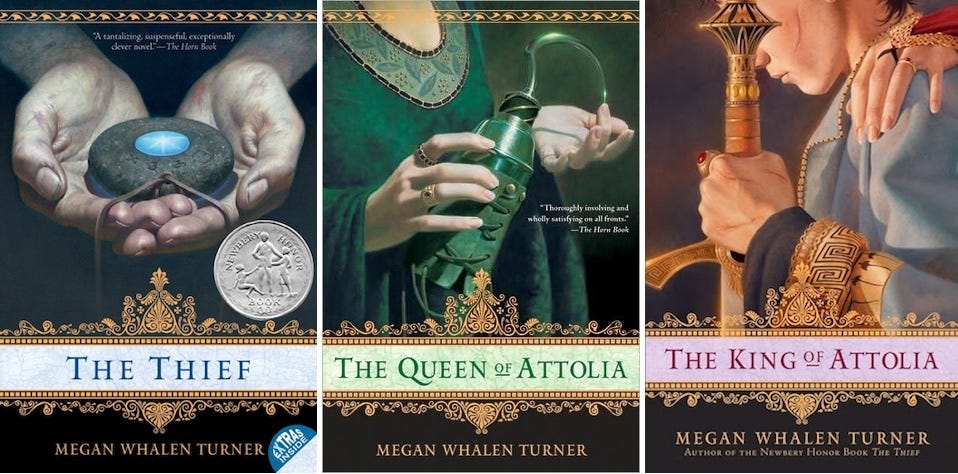
We can understand nobility on the basis of fictional narratives, serving as portals to the mythic archetype. Megan Whalen Turner’s Thief books are one of my favorite fantasy novels series. The title character is a master of stealth, concealment, deception, and disguise. Over the course of the series, he develops into nobility, using his dubious powers for the good of the kingdom.
The Thief series, as a whole, is a meditation on nobility in its manifold manifestations. Another major character is a Queen Regnant. In a memorable scene, she tortures and mutilates a political prisoner. She finds that horrifying and morally repugnant, but also a necessary duty in nobly caring for her kingdom. She is the kingdom, and does what the kingdom must, to preserve itself and its people in the face of imminent foreign threats. How she feels about it, personally, is insignificant in comparison. This is a shocking illustration of conflicts between nobility and moral virtue. How you feel about it, after reading the book, may horrify—and delight—you too.
Positive vision is a Good King’s responsibility
Related to the sense of extending across space, of being your entire kingdom, is feeling that you extend far into the past and into the future. It’s noble to draw on tradition, and noble to care for the future. A Good King does both. In a sense, as king, you are the history of your kingdom; you embody it; and you are the future of the kingdom, even past your own death.
And here the multiple meanings of the word “vision” come into play. Our society and culture seemingly face malaise, stagnation, decay, and crisis. And everyone yells about what they are against. But few have any idea what they are for—apart from destroying what they are against. We are, in other words, lacking in vision. Positive futures have become unimaginable.
Correcting this may be our most important opportunity. And that requires seeing like a Good King. It requires the practical realism of seeing concrete current details and the mythic vision of the sweep of history and grand, meaning-charged future possibilities.
“Authoritarian high modernism,” the way of seeing of a state, failed because the world is too diverse and complex and nebulous and fast-moving for rational representations to keep up. Most grand visions of 1950s science fiction and social theory tacitly assumed homogeneity. Implicitly, they depended on fascism. We will never again agree on a vision. We will never again live in a kingdom.
Rather, we all live in many kingdoms; many spheres of influence; and we each have our own kingdoms, which overlap with others’. This multiplicity and overlap is characteristic of the stage five way of being.
Nobility now means developing visions for our own kingdom that recognize and partially includes the visions of neighboring, overlapping, contained, and surrounding ones. General agreement, or even a broad majority view, are no longer possible. Productive coexistence, dynamic creative tension, and mutual respect with dignity may be superior replacements.
Nobility now means choosing to act justly despite frustrating limits to power. Nobility now demands creativity in the face of uncertainty. Nobility must now deploy the wisdom of acknowledging the pervasive interplay of nebulosity with pattern.
What are your positive visions?
Monarchy, and hereditary aristocracy, are anachronisms. Current systems of government are clearly superior. It may be helpful, when contemplating nobility, to consider specific historical examples of literal good kings; people who ruled well. However, none of them fully embodied the archetype—no one can—so consideration of specifics might get bogged down in arguments about whether they actually were good overall. Examples can be useful only insofar as we identify specific noble choices analogous to current options.
Do you see reliable paths to stage five / nobility that don’t involve meditation/tantra/etc?
This is an exceptional synthesis of developmental psychology, leadership, and mythic cognition—but what strikes me most is the subtle absence of one element: the moment nobility stops being aspirational and becomes structural. At some point, “seeing like a Good King” isn’t a chosen lens—it’s a post-perceptual inevitability. The nervous system itself reorganizes. Perception isn’t broadened—it’s replaced. This is often what people try to articulate as “transcendence,” though most spiritual language muddies it.
What you call stage five, I recognize as the post-transcendent state. Not a metaphor, but a physical, neurological, and perceptual event. From there, nobility isn’t practiced—it’s the only remaining coherence.