


Meta-rational norms acquire moral force in some situations. The covid crisis was one.


The first half of this case study illustrated aspects of meta-rationality using the deadly scientific failures of the World Health Organization, and their correction by Team Airborne.
This half explains how the WHO’s reasoning and actions were also moral failures; and how Team Airborne’s response could be considered noble.
Summary preview:
Meta-rationality connects with ethics in two ways, covered in the first two sections of this post. First, thinking and ➜ acting meta-rationally can be a moral duty when dealing with some practical problems. Second, meta-rationality is sometimes necessary to ➜ clarify difficult ethical judgments. (These sections are rather abstract; the post gets more concrete as it goes along.)
The previous post described a scientific revolution: the replacement of the spray theory of disease transmission with the airborne theory. The WHO resisted that replacement on the basis of fallacious reasoning and inadequate evidence. A section of this post explains ➜ how scientific revolutions work in practice: as gradual reflective negotiations, rather than definitive experimental proofs.
The WHO’s vigor in promoting the spray theory, and extreme reluctance to consider the airborne alternative, suggests that their motivation was not solely rational belief. A section here looks at non-scientific ➜ reasons for resisting scientific theory replacement. Scientific revolutions arrive with costs. In this case, that included financial costs for hospitals and governments, and great losses of prestige, power, and funding for public health agencies.
The very beginning of my discussion of meta-rationality declared that its essence is “actually caring for the concrete situation, including all its context, complexity, and nebulosity, with its purposes, participants, and paraphernalia.” What does that mean? What is the context? What are the purposes?
Especially, who are “the participants”? For ➜ whom do we owe a duty of care? A section considers these questions.
Team Airborne, whose members were mainly physicists, chemists, and engineers, developed the revolutionary replacement theory. Public health authorities initially rejected it on the basis that these were ➜ epistemic trespassers, who had no business intruding on the medical domain. Why would anyone take the wacky claims of these outsiders seriously?
When experts in one domain pontificate about another, often they do just waste experts’ time, confuse the public, and muddy the field. So when is epistemic trespassing justified? A section considers that question. And then another reflects on my own ethical quandaries about epistemic trespassing during the covid crisis. I think ➜ I probably made a moral mistake.
The earlier half of this case study illustrated eight of the twelve meta-rational operations. A section here covers the remaining four. Each ➜ evaluates purposes meta-rationally, as illustrated in the activities of the WHO and Team Airborne.
Three final sections explore connections between rationalism and churlishness, on the one hand; and between ➜ meta-rationality and nobility, on the other.
The moral force of meta-rational norms
In some social roles, in certain circumstances, you have a moral duty to think and act meta-rationally. Public health authorities failed in that duty during the covid crisis.
An earlier chapter contrasted meta-rational norms with reasonable and rational norms. Most people do not have a moral duty of meta-rationality. Most people do not even have a duty to think or act rationally.
In contemporary societies, everyone has a moral duty of reasonableness. That is: you are morally required to give an account of the reasonableness of your activity when challenged.
Rational norms define what it means to think and act rationally.1 In many circumstances, these have no moral force. A student learning aeronautical engineering should think and act rationally when doing homework, but this is not a moral should. It’s just what it means to be a STEM student. If you are an aeronautical engineer, you do have a moral duty of rationality. Failure to follow the rational norms of aeronautical engineering may result in many people dying. In general, rational norms gain moral force when other people depend on your conforming to them.
Meta-rational norms gain moral force when your activity has moral implications, and neither reasonableness or rationality is an adequate guide. When it is unclear how to apply rationality, and rationality has moral force: then the meta-rational work of figuring out how to use rationality well also has moral force.
Meta-rationality is always part of all rational work; but often only as unthought, default choices. When it is overlooked, when it is not understood and not engaged deliberately, it is unlikely to be done well. This obliviousness becomes a moral fault when the rational work itself has moral weight.
In most institutions, meta-rational activity is reserved for particular high-ranked supervisory roles. In contrast, most members must do rational work “by the book”: in accord with the local rational norms. This implies that:
If your role involves supervision of rational work, you have a moral duty of meta-rationality. Specifically: you have a moral duty to monitor whether rationality is working adequately in the current context, for the relevant purposes. If not, you have a moral duty to determine how to correct course.
Institutions organize authority hierarchically. During the covid crisis, most governments and public health institutions deferred to the World Health Organization (WHO), whose advice was disastrously wrong, due to meta-rational failures.
Which technical rationality gets jurisdiction over a category of actual-world concerns may be the weightiest of meta-rational questions. As explained in “Team Airborne meets the WHO,” the WHO delegated covid authority to its Infection Prevention and Control Unit (IPC), whose expertise was completely irrelevant. The IPC authored, promoted, and defended the WHO’s wrong recommendations. The WHO’s leadership’s delegation to the IPC was a critical meta-rational failure.
It was also a moral failure. In a hierarchy, moral responsibility rests ultimately at the top, and is passed down through delegation. In their supervisory capacity, the WHO’s leaders had a moral responsibility to exercise meta-rationality in this situation. Particularly, they had a moral responsibility to monitor whether the IPC’s rationality was working. It was soon obvious that it wasn’t; but the WHO did not course-correct until too late for it to make much difference.
Fluid ethics: the nebulosity and patternedness of moral judgment
Fluid ethics is an approach analogous to meta-rationality, and especially compatible with it. It is not a philosophical system, but a two-part stance. On the one hand, ethical matters are always nebulous, so no theory, method, or standard can guarantee correctness. Yet ethical concerns are also patterned, so when choices must be made, you should do the best you can. That may involve considering ethical theories, methods, or standards if they seem useful in the situation. I’ve discussed this elsewhere,2 and so won’t go into detail here.
This post aims to illuminate patterns of ethical reasoning in rationality and meta-rationality, drawing on the activities of public health authorities during the covid crisis. Where possible, I also draw on their explicit statements, but most of their ethical reasoning is not documented as far as I know. So I will explain some official actions in terms of reasoning they may have used. That will illustrate general patterns even if the attribution is inaccurate.
In some cases I will say “this might be seen as a moral error for this reason; or not, for that one.” This may sound like waffling. Fluid ethics does sound like waffling if you are used to treating ethics rationally.
For many people, a main point of ethics is to assign blame, and to judge individuals or groups as good or bad. Fluid ethics is not usually concerned with that. Ranting about how the public health authorities screwed up is natural, and yes they did. But exhaustive condemnation is rarely helpful.
Also, the authorities did many things right as well as many wrong. I like a recent post by Isaac Saul that adopts a fluid ethical stance:3
If we could go back and do this all again, I think we’d undeniably do things differently… This is all much easier to say now, but even with that knowledge and 20/20 hindsight, wrangling a divided country of 330 million people to a public health cause in a time of emergency was never going to be easy (or, frankly, even possible). Fauci, Trump, Biden, the CDC and FDA all had an incredibly difficult job. Candidly, I have a hard time fully blaming any one of them when so many of us got so much wrong about the pandemic.
Who was morally responsible?
The head of the WHO was Tedros Adhanom Ghebreyesus. He passed responsibility for covid to Mike Ryan, the head of the WHO’s Health Emergencies Programme. In February 2020, at a WHO press conference, Tedros compared covid with Ebola, saying that it is much more dangerous because it’s airborne. Mike Ryan, sitting next to him, scribbled a note and passed it to him. Tedros then apologized to the audience for misspeaking: “Sorry. I used the military word ‘airborne’. It meant to spread via droplets or respiratory transmission. Please take it that way.” This interaction remains somewhat mysterious.
However, it’s clear that Ryan considered it important from the beginning to tell the public that covid was not airborne. Also in February 2020, he recommended against masks for the public: “There are limits to how a mask can protect you from being infected. The most important thing everyone can do is wash your hands, keep your hands away from your face and observe very precise hygiene.”
So, arguably, he bears primary responsibility for the WHO’s disastrously wrong guidance. I presume (but do not know for sure) that he was responsible for passing authority down the chain of command, choosing to delegate the details of covid response to the IPC, who botched it.
As so often with bad meta-rational choices, he may have made that decision with little consideration. It’s right there in the name: the crisis demanded infection prevention and control, and the IPC is the Infection Prevention and Control Unit.
I’ll return to the question of Ryan’s culpability at the end of this post. My answer may surprise you.
Theory replacement is always a social negotiation
Scientific revolutions replace an established theory with a new alternative. “Establishment” is a social fact: the consensus opinion of experts. That shifts gradually, as individual scientists weigh the two theories and, at different points, decide to support the new one.4
This is a social negotiation: scientists argue, and sometimes change each others’ minds. “Social process” is often misunderstood to mean “power politics,” which always does play some role. However, when science is working well, politics are secondary. The social process is people working together in good faith to figure out which theory is better.
Scientists are not necessarily good at social negotiation. That makes theory competition vulnerable to power interests with non-scientific motivations.
In the covid crisis, science wasn’t working so well. Power interests interfered, and politics played an outsize role. We saw some of that in “Meta-rational failure in the covid crisis,” and there’s more coming in this one. The somewhat dysfunctional process did converge on the right answer—but only too late for it to help much practically.
“Better,” when evaluating scientific theories, is unavoidably somewhat nebulous. It’s a matter of weighing multiple sorts of “goodness” relative to contexts and purposes.
“Good” includes “consistent with evidence.” However, as the previous post explained, there is always some experimental evidence that contradicts any scientific theory, and some that supports any theory. This was true of the miasma vs. germ theories of disease, and of the spray vs. airborne theories.
The sorts of evidence regarding competing theories are often qualitatively different, so they can’t be compared quantitatively. That was true of the evidence supporting the spray theory versus the airborne theory. As we saw in the “What types of evidence should we consider meaningful” section of the previous post, this was a main source of disagreement between the IPC and Team Airborne.
In a scientific revolution, what count as the topics of study, the standards of evidence, and the standards of explanation are all up for grabs. Different scientists disagree about how significant which bits of evidence are. Any theory is compatible with any set of data, if you reject enough of it as measurement error, ignore bits as exceptions that prove the rule, explain them by stretching the theory out of shape, and so on. Therefore, theory competition cannot be resolved by rational calculation.
This does not imply that the dispute is resolved by anti-rational woo (“intuition”), nor by arbitrary “social construction.” A scientific revolution resolves meta-rationally, by opening rational conceptual structures to ontological doubt, and by asking how in practice they relate to observable reality (circumrationality).
The structure of resistance to scientific revolutions
Why did the WHO refuse to reconsider for so long?
Thomas Kuhn’s Structure of Scientific Revolutions holds that established theories get displaced only in a crisis. Typically, that is the discovery of a major anomaly, which the standard theory cannot accommodate, even with revisions.5 In this case, instead, a humanitarian and political crisis created the conditions for a scientific crisis.
A “paradigm shift” typically takes many years; often decades. Covid forced one over about two years. Team Airborne’s leaders had been arguing for the airborne transmission of respiratory diseases for more than a decade, and no one listened. Without the drama of covid, it might have taken decades longer. (We are still waiting for official acknowledgment on flu, RSV, and colds, which are all probably airborne too.)
Revolutionary scientific changes may cause personal and institutional crises as well as abstract scientific ones. Therefore, rational individuals and institutions often resist theory replacement, even when it is scientifically justified.6
Working out the new theory’s consequences usually requires meta-rationality, which rational professionals are not trained in. That uncomfortable new work displaces the routine rational tasks they signed up for and would prefer to continue.
Activities downstream from the old theory—all its practical implications—must be rethought, revised, perhaps replaced. This also requires unexpected work, of unwanted sorts.
The changes to practice implied by the new theory may be financially and administratively expensive for institutions.
The social prestige, political power, and expert identity of individuals and institutions depended on the old theory. Theory failure may sweep all that away.
Replacement creates vertigo in the face of nebulosity: uncertainty, confusion, and loss of control. Many find that uncomfortable, or even intolerable. This may be the main motivation for resisting most scientific revolutions.7
The following sections detail the first four of these. The fifth didn’t play a role in the covid crisis as far as I know, so I won’t discuss it further here.
Meta-rationality is frightening and violates rational institutional norms
Deciding between competing scientific theories requires meta-rational judgment, which no one is formally educated in. Professionals may pick it up on the job, or through apprenticeship. Even then, most find it uncomfortable because they know they don’t know how to do it well. They would rather stick to the rational methods they’ve mastered.
In this case, the meta-rational work had already been done by Team Airborne. So all the IPC had to do was to make the meta-rational decision to accept the new theory on the basis of the evidence.
My impression is that they did not consider this part of their job. Under normal circumstances, they would be right! Public health is policy, administration, and service delivery, not science. The job is to get people to do things, based on whatever the current scientific consensus is. It is mostly not the job of public health committees to evaluate scientific evidence; that is a job for the scientific community. For a WHO committee to declare that the current consensus is wrong, and to make policy decisions based on their idiosyncratic reevaluation of evidence, would be an illegitimate violation of its mission.
However, the then-current consensus theory—the spray theory—was wrong, and was killing people by the hundreds of thousands. It’s a meta-rational moral principle that rational institutional norms may be set aside in a crisis. Refusing to do that was understandable, but a moral failing.
It is a meta-rational norm to remain aware that there are many things which you don’t know that you don’t know, some of which may turn out to be relevant. It is a norm to be curious about things that you do know you don’t know, which you suspect are relevant. It is a norm to actively investigate them, to the extent resources permit.
The IPC failed to do that. Because it had authority over the rational operations of global covid response, meta-rational norms had moral force. Those operations were enormously consequential, so failing to ask “could the established science be wrong?” was a catastrophic moral failing.
Alternatively, it’s possible that the IPC made a deliberate meta-rational judgment that they didn’t have the resources to consider the airborne theory. “We don’t have time for belief revision in the middle of this crisis, so we have to deal with the situation using the tools at hand.” That would have been a mistake, but not a violation of meta-rational norms, nor necessarily a moral failure. (From what I have read, I don’t think they did this.)
Scientific revolutions entail unwanted intellectual work
Displacing the foundational theory of a discipline implies reexamining all the details it had seemed to imply. The replacement theory will have different implications. Figuring out what needs to change may be a ton of unexpected work. Scientists often resist accepting theories to avoid that. For administrators, fundamental change is particularly unwelcome in the midst of a practical crisis.
Mary-Louise McLaws, a member of the IPC, said “If we started revisiting airflow, we would have to be prepared to change a lot of what we do. It will cause an enormous shudder through the infection control society.”8
Fortunately, Team Airborne had already done the scientific work. The answer was: airborne transmission implies wearing N95 masks, better ventilation, and germicidal UV. They’d been advocating these measures for a decade (and going back to the Wells experiments, most of a century earlier).
That left the administrative work: revising a ton of documents, holding press conferences, organizing professional trainings and conferences, communicating the new policies to hundreds of institutions around the world. Plus taking the flak for “why should we believe you, why do we have to change now, why didn’t you tell us before, how could you have screwed up so badly!”
Doesn’t sound like a lot of fun.
Changes to practical activities are expensive
Institutions, especially governments and hospitals, strongly resisted the airborne theory’s practical implications for cost reasons. They successfully pressured public health authorities to delay and downplay promoting them.
Direct financial costs included buying N95 masks and upgrading ventilation.9 N95 masks were in extremely short supply due to earlier government bungling, which drove up the price. (We’ll come back to that later in this post.)
Additional costs were administrative and attentional. Changing work rules to require N95 masks and dealing with employee push-back was one more goddamn thing we are supposed to do in the middle of a crisis in which we are already overwhelmed. Nobody wants that. One way of resisting was to invent outlandish training expenses and hypothetical medical harms of wearing N95s. These all turned out to be minor or entirely fictitious, but they successfully stalled deployment for months in some cases.
Loss of power, authority, status, and financial rewards
Those happened in this case: getting covid wrong drastically damaged the credibility and authority of the agencies, their staff, their entire professions, and governments.
I featured Linsey Marr, a leader of Team Airborne, and John Conly, the Chair of the IPC covid committee, in the previous post. She said of him:
Frankly, I think he just can’t admit he’s wrong. He does carry a lot of weight with WHO, and unfortunately I think his thinking is still stuck in what we knew 20 or 30 years ago and hasn’t updated with what we’ve learned since then — and especially what we’ve learned over the past year.10
At the institutional level:
A desire to save face by some authorities may have also played a role. Both individuals and public bodies had emphatically declared airborne transmission to be “misinformation”. It would be embarrassing to subsequently acknowledge such an important mistake.11
Confident but wrong factual claims, harmful coercive policies, and repeated reversals caused massive loss of public trust in science, medical expertise, and government institutions. In accord with public sentiment, governments have significantly cut funding for science. Some are promoting harmful and irrational public health policies.
This is likely irrecoverable. In the long term, it may have even worse consequences than covid itself. At best, it will take a generation to restore institutional competence and credibility.
For who and what do we care?
My overall explanation of meta-rationality began:
The essence of meta-rationality is actually caring for the concrete situation, including all its context, complexity, and nebulosity, with its purposes, participants, and paraphernalia.
It is natural (and right) to ask: What does all of that mean?
What is “the situation”? What do you mean by “context,” and how is it complex and nebulous? What are the purposes? Who are the participants, and what paraphernalia is relevant?
Rationality takes these items as givens. Explicitly or implicitly, they must be supplied in a Problem statement. Approaching this “essence of meta-rationality” explanation with a rational mindset, one would demand definitions for the terms. “What method can I use to determine who is ‘a participant’ and who isn’t?”
Meta-rationality recognizes that these matters are all nebulous, so no general definitions or methods are possible. However, in any particular situation, getting a handle on them is critical to creating a good outcome. Therefore, “what are the purposes” and “who are the participants” are questions for ongoing meta-rational investigation. It is a meta-rational norm that you do so, that you find provisional answers, and that you leave the possibility of revising them permanently open.
For the WHO IPC, the concrete situation was having been told to issue global guidelines for covid response. Whatever they said would affect many diverse constituencies (“participants”). Those bore different contexts and conflicting purposes. These interests were incommensurable, so they could not be weighed rationally. Making decisions in the face of qualitative trade-offs is a meta-rational practice. In this case, I have found no evidence that the IPC considered the conflicts at all. They seem to have jumped to a default decision immediately.
A section at the end of this post discusses meta-rationality in evaluating and revising purposes meta-rationally.
Concerning “paraphernalia,” N95 masks were the most relevant, and public health authorities’ recommendations centered them. “Do not wear masks, you don’t need them, because covid is not airborne!” This was their message to the public on February 2nd, 2020, a week after the Chinese government first informed the outside world that covid had gone epidemic:
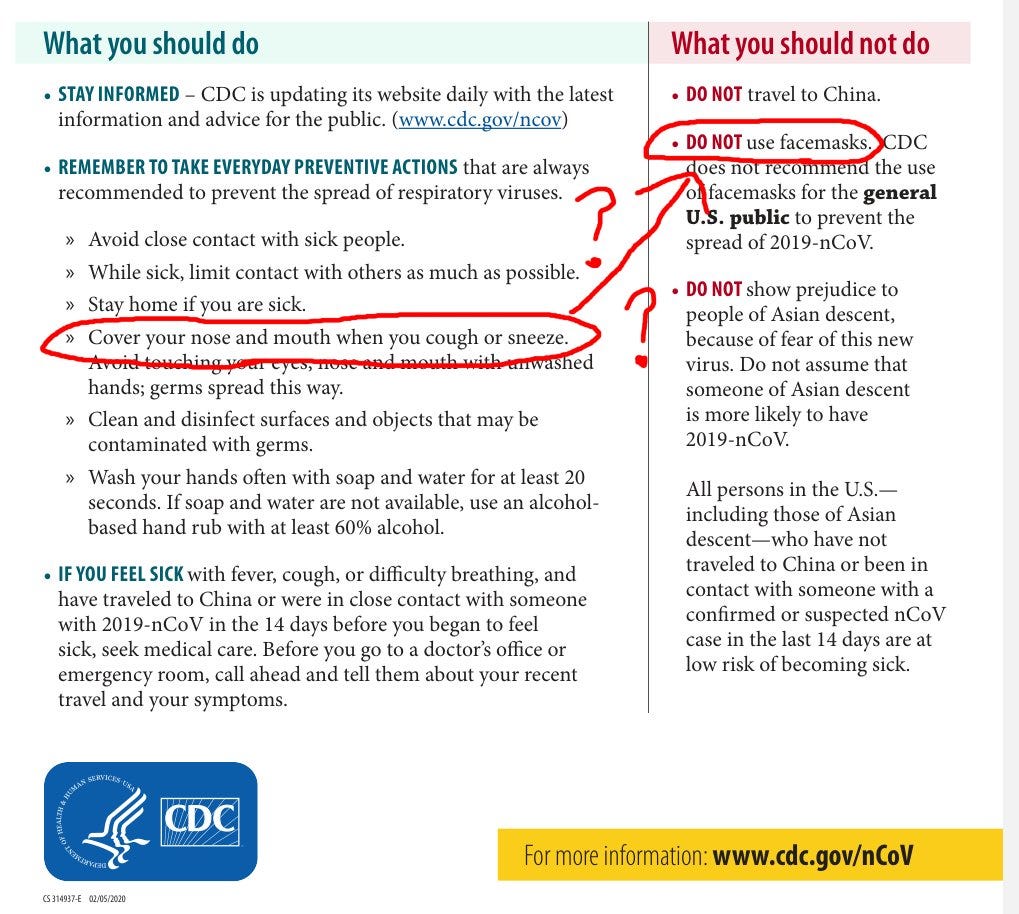
Although the IPC’s paper responding to Team Airborne’s challenge argued that covid is not airborne, its main point was that N95s are unnecessary and potentially harmful. From its abstract:
Based on the scientific evidence accumulated to date, our view is that [covid] is not spread by the airborne route to any significant extent and the use of particulate respirators [N95 masks] offers no advantage over medical masks as a component of personal protective equipment for the routine care of patients with COVID-19 in the health care setting. Moreover, prolonged use of particulate respirators may result in unintended harms.12
The previous post discussed gross flaws in this paper’s attempt at rationality. Its explicit central argument depended on a reversed logical implication, concerning the physical distance the virus could travel.
A careful reading suggests that the motivation for the IPC’s rejection of airborne transmission was another reversed implication. Implicitly: we really really don’t want to recommend N95 masks, therefore they must be unnecessary, therefore covid cannot be airborne. Although explicitly: covid is not airborne, therefore N95 masks are unnecessary, therefore we do not recommend them.
Why? It was a purpose of several sorts of “participants” to prevent an N95 recommendation.
Prior to the covid crisis, the IPC’s main constituency had been hospital administrators, because the IPC’s main job was to get health care workers to wash their hands. The American Hospital Association strongly objected to N95 mandates a few months later:
“A rigid new standard has real potential to add for hospitals and health systems a new layer of conflicting and impractical regulatory burden at precisely the wrong time,” the association said. To back that request, it pointed to the CDC’s current recommendations to control Covid-19. “The CDC continues to hold that COVID-19 is primarily spread through close contact, not airborne transmission,” the association declared. And it was true: the CDC had yet to officially change its guidance.13
I expect most people would consider the purpose of protecting the general public from a sometimes-fatal pandemic should outweigh administrative hassles for hospitals. However, if the IPC mostly talked to hospital administrators, their concerns would be top-of-mind. This may have been unconscious, or at least not carefully thought-through. I doubt their “not airborne” proclamations were deliberately mendacious, much less evil or uncaring. They just prioritized the wrong purpose, based on an unthought meta-rational judgment about who “the participants” were.
Another relevant group of participants were frontline health care workers. The IPC may have thought: “It’s hard enough to get hospital staff to wash their hands, they resent like hell our telling them to, if we tell them they have to wear N95s as well, they’ll just totally rebel, lose respect for authority, and stop washing their hands.”14 (This is the same argument Nightingale and Chapin made, more than a century earlier.)
In fact, health care workers themselves were split on the issue, due to weighing differently the risks to patients, to themselves, and the discomfort of wearing a mask all day.15
The WHO is an agency of the United Nations, answerable to global governments, especially the US, which supplied its largest chunk of funding. Various pieces of the US government were participants in the situation, with their own purposes.
In 1998, the government created the Strategic National Stockpile of supplies essential for responding to a lethal flu epidemic. N95 masks were a main component. In 2009, most were distributed during the swine flu pandemic. The Stockpile was not refilled afterward, and had dramatically fewer N95 masks than were needed for covid. This was due to bungling and neglect by multiple government authorities over a decade.
In 2016 the US National Security Council developed a pandemic plan with recommendations for what to do in the face of different pathogens, particularly those capable of “rapid airborne transmission.” This was explicitly dropped by the first Trump administration, and then forgotten and ignored.
My suspicion, shared by many during the crisis, was that official public health statements were crafted to avoid embarrassing governments for their culpability in the crisis. This was most obviously true in the obsequious deference to the Chinese government, despite (or because of) the Chinese obstruction of the WHO’s investigation.
Saying “the best way to protect yourself is with an N95 mask” would prompt the question “why can’t we get them,” to which the honest answer would be “because your government screwed up badly,” which the WHO and US CDC would not risk.
In fact, initial insistence that masks were unnecessary for the public was motivated partly by wanting to save critically short supplies for health care workers.16 This was a “noble lie,” arguably morally justified.17 This fit a pattern we saw repeatedly in the last post, going back more than a century. Public health authorities proclaimed exaggerations, bordering on lies, in order to get the public to do what the authorities thought would be good for them.
“Noble lies” may be consistent with a consequentialist ethical framework, although dubious deontologically. In this case, prioritizing health care workers over the general public may also have been justifiable in consequentialist terms early in the pandemic, although dubious deontologically.
However, deliberately misinforming the public traded off concern for the present context, purposes, and participants against future ones. The public overgeneralized: from revelations of deceptions and screw-ups, to stubborn resistance to all public health efforts. There are already significant consequences, including a measles epidemic in the US. More seriously, loss of institutional credibility will make it much harder to respond effectively to the next pandemic.
A final aspect of “who are the participants?” turns on the WHO’s mandate as a United Nations agency. Their main function in practice is to advise poor countries to adopt policies established in rich countries. Several members of the IPC opposed recommending N95s on the grounds that poor countries would not be able to afford them (although rich countries could). I find this an unambiguous failure of moral logic.18
Epistemic trespassing
Linsey Marr, a leader of Team Airborne, has been described as an “epistemic trespasser.”
Epistemic trespassers judge matters outside their field of expertise. Trespassing is ubiquitous in this age of interdisciplinary research and recognizing this will require us to be more intellectually modest.19
This points to a genuine danger: experts in one domain pontificate about others in which they are mainly ignorant, apparently unaware that they are spouting nonsense. Their prestige may lend credence to misinformation.
Similarly, any prominent scientist gets a constant stream of interrupts from cranks who have proven that Einstein was wrong, have figured out how consciousness really works, or have discovered the cure for cancer using magnetic auras.
A bunch of HVAC engineers on twitter saying they were overthrowing a century of medical science with their new theory of disease transmission matches that pattern well. You can see why the IPC was not inclined to take Team Airborne seriously.
We are the World Health Organization’s Infection Prevention and Control Unit. Why are you arguing with us about disease transmission?!?!
Soon after, Benedetta Allegranzi, the head of the IPC, “questioned the qualifications of those driving the debate”:20
There is this movement, which made their voice very loud by publishing various position papers or opinion papers. Why don’t we ask ourselves … why are these theories coming mainly from engineers, aerobiologists, and so on, whereas the majority of the clinical, infectious-disease, epidemiology, public-health, and infection-prevention and control people [disagree]?”
From the other side, Jose-Luis Jimenez of Team Airborne said their meeting with the IPC “felt surreal. None of [our] evidence was taken seriously. There was an attitude of condescension, that they were superior and that they knew what was going on and that we didn’t.”21
Team Airborne might have replied:
We are the world’s recognized experts on what gets expelled from lungs and the physics of how that travels through the air. Why are you arguing with us about fluid dynamics?!?!
But, although I have made the rejoinder symmetrical, this was not a symmetrical situation. And not only because the IPC was wrong and Team Airborne was right. But because the IPC’s whole theory of airborne disease transmission could be written on the back of an envelope, whereas Team Airborne brought enormous expertise.
The IPC didn’t know what they didn’t know, and moreover didn’t care and wouldn’t listen. They were not equipped to understand how fluid dynamics—the physics of flow, including airflow—was more relevant than poetics or archaeology. By contrast, Team Airborne, when they realized they couldn’t understand the IPC’s view, figured it out—better than the IPC understood it themselves.
Trespassers brought relevant knowledge unavailable to public health insiders, but also different ways of thinking. For example, an engineer’s job is to design a mechanism that causes a desired effect. Engineers are trained to consider and compare many possible causal mechanisms within a single project. Invention is meta-rational work not included in science education.
Historical studies of scientific breakthroughs often observe that engineers drove a field forward. The usual explanation is that they create measuring instruments that reveal new data. Perhaps it’s also for this other reason: design and invention are ways of thinking that are particularly relevant during crises.
My own moral quandaries concerning epistemic trespassing
During the first year of the crisis, I followed covid discussions closely, particularly on twitter. That was partly for practical reasons, to help protect myself and my family; and partly out of intellectual interest. I was torn about how much to contribute myself.